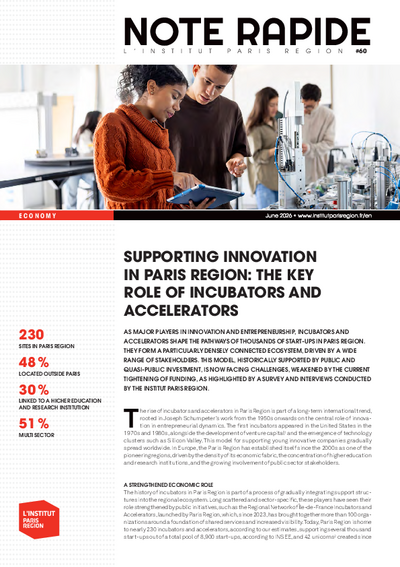
Supporting innovation in Paris Region: the key role of incubators and accelerators
As major players in innovation and entrepreneurship, incubators and accelerators shape the pathways of thousands of start-ups in Paris Region. They form a particularly densely connected ecosystem, driven by a wide range of stakeholders. This model, historically supported by public and quasi-public investment, is now facing challenges, weakened by the current tightening of funding, as highlighted by a survey and interviews conducted by the Institut Paris Region.
The rise of incubators and accelerators in Paris Region is part of a long-term international trend, rooted in Joseph Schumpeter’s work from the 1950s onwards on the central role of innovation in entrepreneurial dynamics. The first incubators appeared in the United States in the 1970s and 1980s, alongside the development of venture capital1 and the emergence of technology clusters such as Silicon Valley. This model for supporting young innovative companies gradually spread worldwide. In Europe, the Paris Region has established itself since the 2000s as one of the pioneering regions, driven by the density of its economic fabric, the concentration of higher education and research institutions, and the growing involvement of public sector stakeholders.
A STRENGTHENED ECONOMIC ROLE
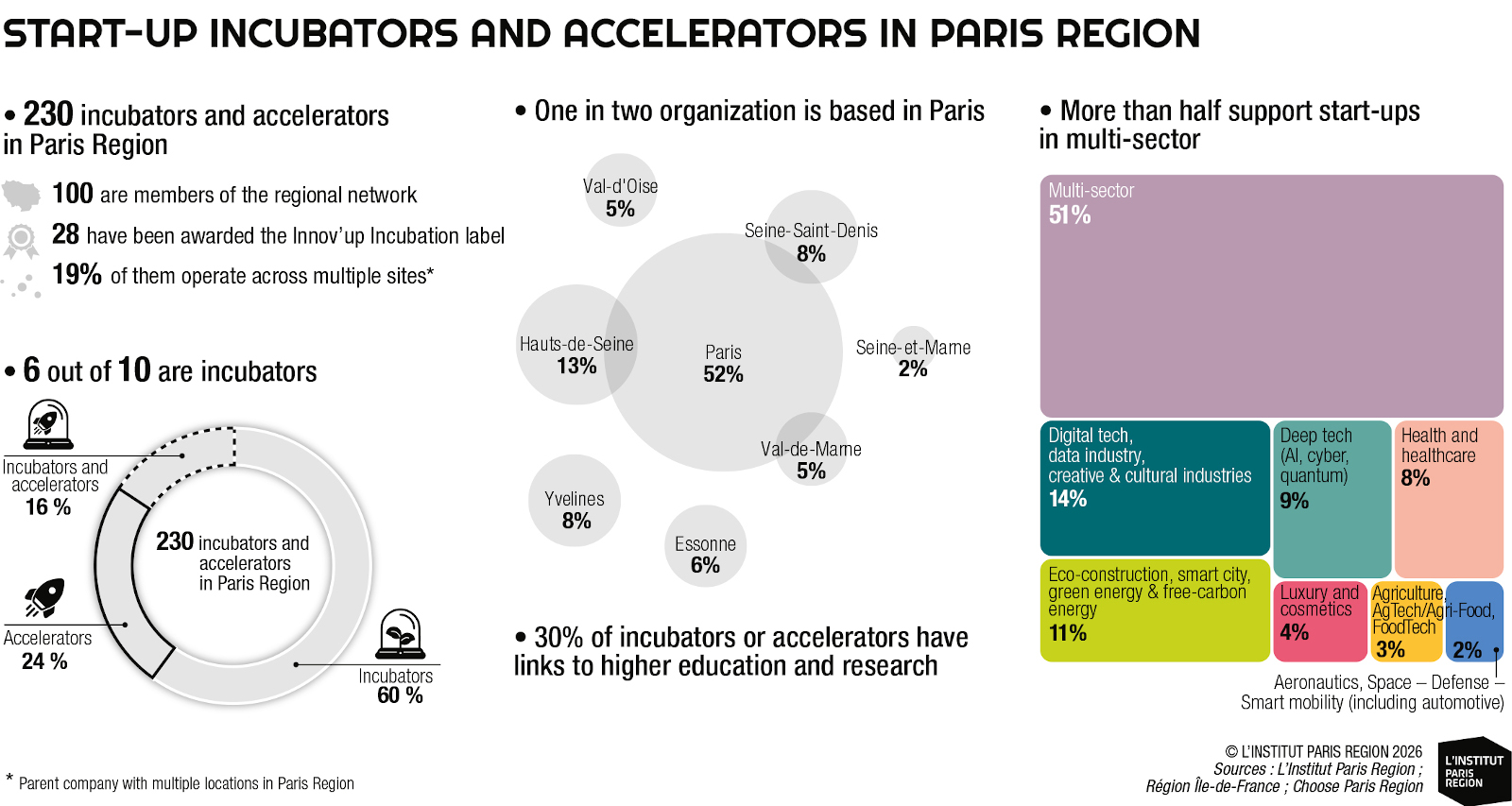
The history of incubators in Paris Region is part of a process of gradually integrating support structures into the regional ecosystem. Long scattered and sector-specific, these players have seen their role strengthened by public initiatives, such as the Regional Network of Île-de-France Incubators and Accelerators, launched by Paris Region, which, since 2023, has brought together more than 100 organizations around a foundation of shared services and increased visibility. Today, Paris Region is home to nearly 230 incubators and accelerators, according to our estimates, supporting several thousand start-ups out of a total pool of 8,900 start-ups, according to INSEE, and 42 unicorns2 created since 1990, according to Dealroom’s website3. Backed by an exceptional economic and scientific ecosystem, these start-ups position the Paris Region among Europe’s leading regions for innovation. At the heart of this landscape are iconic names that have significantly contributed to the visibility of the Paris Region ecosystem both nationally and internationally. Station F, opened in 2017 in Paris, has established itself as a global benchmark. Certain incubators play a particularly pivotal role in supporting projects emerging from higher education and research, particularly in the scientific fields and cutting-edge technologies: Agoranov, IncubAlliance, Paris Biotech Santé (long-standing players in deep tech4 support), for public research incubators; X-Up (Polytechnique), the Telecom Paris incubator, the Arts et Métiers incubator, PC’up (ESPCI), and ESSEC, for incubators affiliated with engineering and business schools. Beyond these leading figures, the Paris Region ecosystem relies on a variety of generalist organizations, such as Paris&Co or the Wacano incubators, subsidiaries of the chambers of commerce and industry, as well as on programs specialized by sector or stage of development, covering digital technology, health and biotech, artificial intelligence, energy and cleantech5, Industry 4.0 and social innovation.
“An incubator is, above all, a place for intensive support, where we structure the project, challenge the team and maximize the chances of success in the market. We aim to attract the best.” Jean-Michel Dalle, Director, Agoranov
“Our aim is to transform research outcomes into high-potential businesses: deep tech support helps refine the product-market fit, the business model and the team, and facilitates connections with financial and industrial stakeholders.” Arielle Santé, Managing Director, IncubAlliance Paris-Saclay
“Impact is now a key criterion in project selection, just as much as innovation.” Sophie Vannier, Director, La Ruche
A DENSELY CONNECTED TERRITORY AT THE HEART OF THE REGIONAL ECOSYSTEM
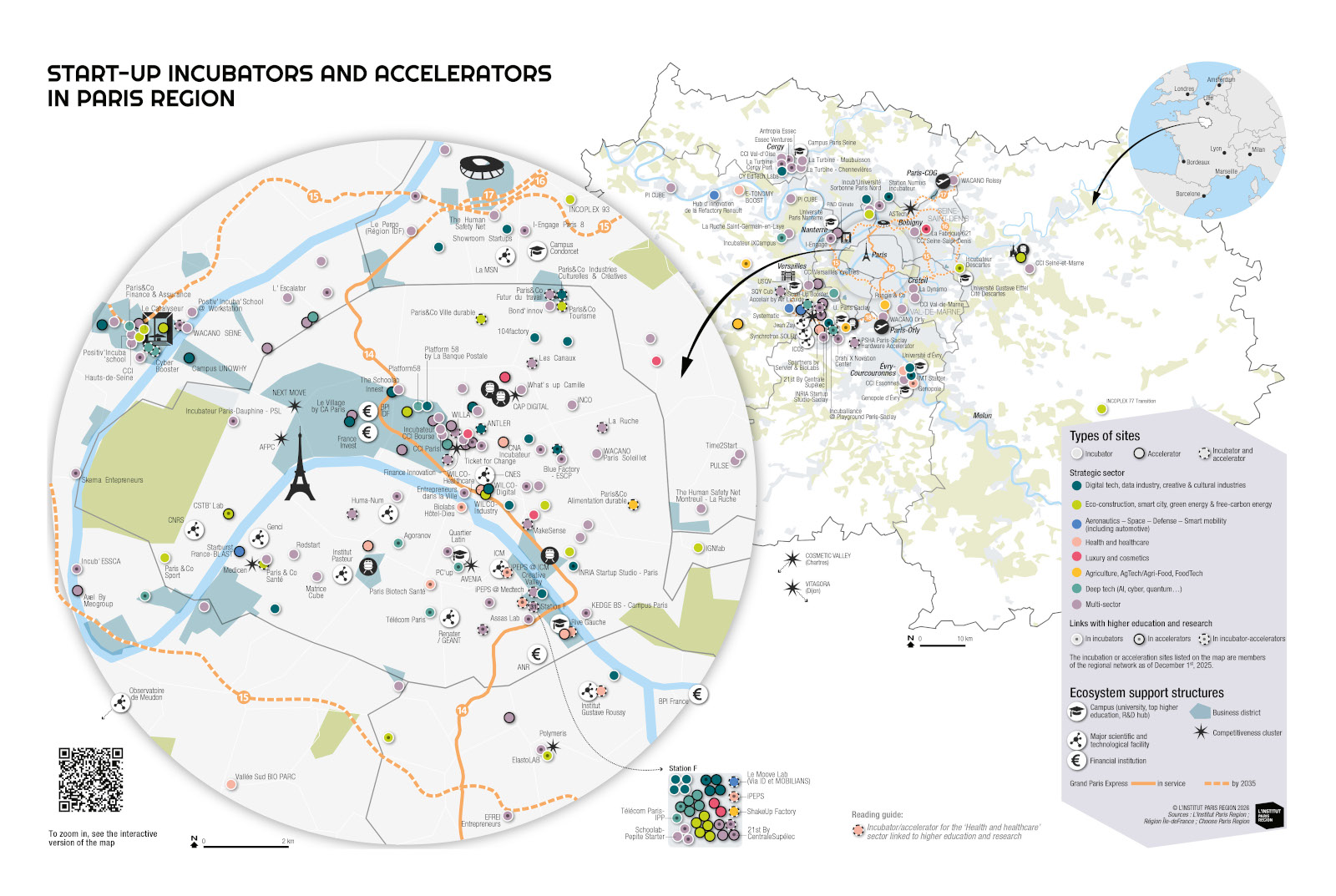
At European level, Paris Region is regularly cited as one of the best-performing ecosystems, alongside London, Amsterdam and Berlin, particularly in rankings focusing on innovation and entrepreneurship6. This position is underpinned by a particularly dense regional network of incubators and accelerators, both generalist and specialized (health, digital, deep tech, impact and industry), supported by a wide variety of stakeholders: top higher education institutions and universities, research institutions, local authorities, large companies, associations and private funds. This concentration can be explained by the presence of renowned innovation and R&D hubs, such as central Paris, the Saclay plateau or the major economic regions of the metropolitan area, which offer privileged access to talent, research infrastructure and funding bodies. The regional map of incubators and accelerators highlights this strong concentration, whilst revealing a gradual spread of these structures towards the outer suburbs, often linked to local economic development strategies. The role of inter-municipal bodies is crucial in this dynamic. Areas such as Paris-Saclay, Saint-Quentin-en-Yvelines, Évry and Cergy-Pontoise rely on incubators to attract start-ups, capitalize on their scientific resources and boost their economic appeal. The coexistence of a very dense provision in Paris and localized schemes on the outskirts fuels both a form of competition and a diversification of support models.
A UNIQUE MODEL BASED ON THE INTERCONNECTION OF RESEARCH, INNOVATION AND PUBLIC ACTION Compared to major American ecosystems, Paris Region stands out for the depth of its regional network, the central role of research institutions and structural public support. Incubators in the Paris Region maintain close links to higher education and universities and research bodies, particularly within the framework of university innovation clusters, such as IP3 (Institut polytechnique de Paris and partners) and Alliance Université Paris-Saclay. Supported by the France 2030 plan, these initiatives aim to strengthen technology transfer and increase the number of deep tech start-ups emerging from public research, through tools such as calls for pre-maturation and maturation projects, the i-PhD competition, the CNRS’s RISE program, and Inserm’s support programs. Recognizing their pivotal role in transforming scientific results into entrepreneurial projects, the Region actively supports public research incubators. Paris Region is also committed to structuring the ecosystem through the Regional Network of Île-de-France Incubators and Accelerators, the Innov’up Incubation certification, funding for Major Innovation Hubs, and the full range of start-up support schemes, including, most recently, the Femtech fund (total allocation of €50 million).
FROM DEEP TECH TO SOCIAL INNOVATION: A DIVERSE RANGE OF SECTORS RECEIVING SUPPORT
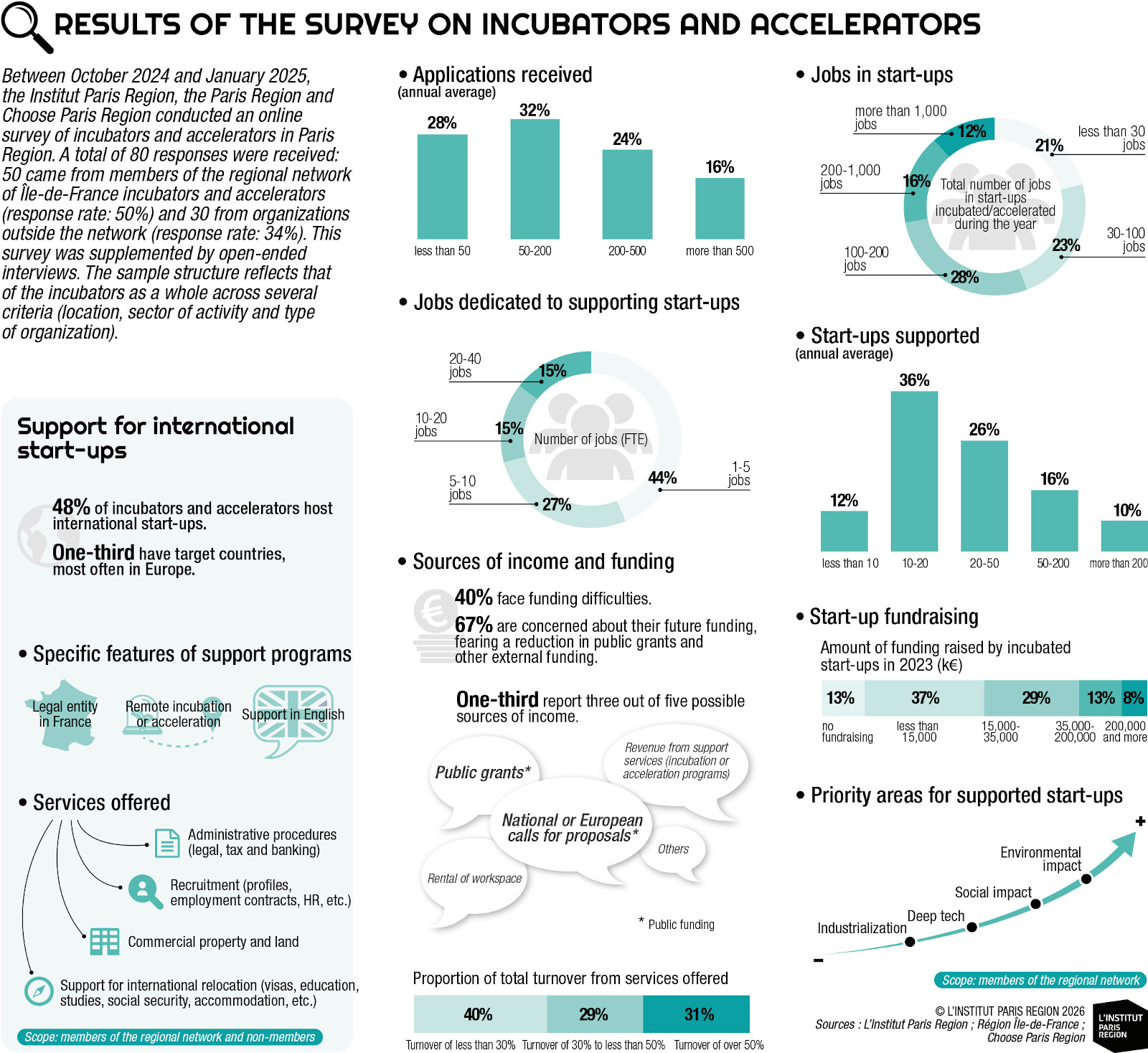
According to a survey of incubators and accelerators in Paris Region conducted by the Institut Paris Region, Choose Paris Region and the Paris Region (see below), these organizations support between a few dozen to several hundred projects each year, depending on their size and specialization. The services offered to start-ups vary: specialized and targeted programs, accommodation (offices, laboratory benches, etc.), and additional services (access to experts, networks, mentoring, training, etc.). The companies supported have three-year survival rates that can exceed 70–75%, often higher than those of non-incubated start-ups (around 50%). Among the iconic success stories are Alice et Bob, Fairmat (incubated by Agoranov), Sirius Space Services (IncubAlliance), QubitPharmaceuticals and Raidium (Paris Biotech Santé), Alan (Station F) and Vestiaire Collective (Paris&Co), illustrating the ability of the Paris Region’s schemes to foster the emergence of high-potential companies, including on the international stage. The sectors covered are diverse: digital, health, industry, mobility, as well as deep tech, industrialization, and social and environmental innovation. Social and environmental innovation is emerging as a defining trend, embodied by organizations such as La Ruche or Willa (an incubator dedicated to female entrepreneurship), which incorporate social or environmental impact as well as diversity as central criteria for selecting and supporting projects. Deep tech is also playing an increasingly significant role, driven by public research incubators or iXcampus, which offer long-term support tailored to technological and industrial cycles. Biolabs, with a presence in Paris (Hôtel-Dieu) and Saclay (Spartners by Servier), offers a unique positioning within the health-biotech sector as does Genopole, which is supported by state-of-the-art platforms. All these organizations play a key role in removing the scientific, financial and regulatory barriers faced by researcher-entrepreneurs.
“Support structures play a key role in breaking down barriers to women’s entrepreneurship and promoting gender diversity in tech.” Flore Egnell, General Delegate, Willa
“We provide incubators and accelerators with expertise in photonics and quantum technology by facilitating access to shared state-of-the-art infrastructure and equipment, a network of investors for industrial projects, and talent ranging from qualified technicians to co-founders.” Clara Doly, Director of Partnerships, and Guillaume Aubard, Director of Deep Tech Programs, iXcampus8
“Being based within a hospital fosters collaboration between doctors and entrepreneurs on shared interests.” Johanna Michielin, Director for Europe, Biolabs
AN ECONOMIC MODEL UNDER PRESSURE AND UNDERGOING TRANSFORMATION
The model of incubators and accelerators in the Paris Region is currently facing several vulnerabilities. The tightening of venture capital and seed funding is affecting all organizations. The reduction or instability of public and quasi-public funding is also forcing them to rethink their business model, pool certain functions or refocus their activities on a smaller number of projects. The closure or repositioning of certain incubators, such as The Family, 1kubator and Entrepreneurs First, illustrates this fragility, whilst highlighting the specific difficulties faced by schemes focused on hardware9 and industrialization. In this context, ‘start-up studios’10, such as Hexa, Redstart, the Inria Startup Studio iPEPS or Technofounders, stand out for their ability to internalize start-up creation by mobilizing multidisciplinary teams and dedicated funding, often in direct connection with venture capital funds. There is also a trend towards pooling resources: networking initiatives for these structures, such as those led by La Boussole (France Digitale), the Regional Network of Île-de-France Incubators and Accelerators, the Impact Lab Academy and European consortia, promote the exchange of best practices, international visibility and access to resources for project leaders. This collective momentum strengthens the resilience and attractiveness of the Paris Region ecosystem. Despite economic challenges and the need to adapt business models, incubators remain a key pillar of start-up development, the commercialization of research and the transformation of the regional economic fabric. Their ability to innovate in support services, to network, and to address societal and technological challenges will determine their role in the coming decade.■
1. Funding for the creation or development of a high-risk but high-potential business, in the form of an equity investment.
2. Unicorn: tech company that is currently valued at over $1b.
3. Global Tech Ecosystem Index 2026.
4. Deep tech: disruptive technologies referring to innovations based on advanced scientific or technical research, aimed at solving complex problems.
5. All technologies, products, services and processes aimed at reducing environmental impact.
6. Financial Times: Europe’s Leading Start-up Hubs: rankings.ft.com/incubator-accelerator-programs-europe/ranking/ europes-leading-start-up-hubs ; Startup Genome: The Global Startup Ecosystem Report 2025: startupgenome.com report/gser2025/regional-rankings-2025.
7. Scaling up of a company that has already validated its business model and is experiencing rapid growth, in terms of both turnover and workforce or market share.
8. Focus on deep tech and hardware with a 100% industrial focus.
9. All of the physical, tangible hardware components of a technical system, as opposed to intangible elements such as software or data.
10. An organization that creates, guides and directly and systematically funds its start-ups.
INCUBATORS AND ACCELERATORS: STRUCTURES SUPPORTING INNOVATION
An incubator aims to transform an idea into a viable project by validating the concept and business model, typically through programs lasting between 6 and 36 months. 10% are not linked to a time-limited support program. They are run by a variety of public and private stakeholders: local authorities, large companies (internal or external incubators), higher education institutions, research institutions or associations. They operate under various legal frameworks (associations, commercial companies, hybrid structures, etc.). An accelerator aims at start-ups that have already been established, in order to accelerate their growth (scale-up phase7) over short cycles, generally less than 12 months, often with a view to raising funds. These two structures differ from third places, incubators, business incubators, business centers and start-up campuses, which operate under different models of support or accommodation.
This study is linked to the following theme :
Economy